Released ~4.4 million years ago
Ardi
Intelligence between worlds.
An adaptable embodied architecture. Perception and movement work together across different operating environments.
- Neural capacity
- 22–26BNeurons · estimated
- Peak deployment
- 100KDevices · Illustrative scenario
Integrated movement
Ardi brings multiple movement modes into one architecture. Its operating configuration supports different terrain within the same embodied system.
Retained interfaces
Grasping and ground contact remain part of the same capability stack. Ardi retains useful interfaces as its operating range changes.
Model card
- Release estimate
- ~4.4 million years ago
- Cranial capacity
- 300–350 cm³
- Checkpoint
- ARA-VP-6/500
- Training region
- Aramis, Middle Awash, Ethiopia
- Brain capacity
- Endocranial capacity 300–350 cm³
- Form factor
- About 120 cm, 50 kg
- Weights recovered
- Partial skeleton: much of the skull, hands, feet, limbs and pelvis
- Locomotion
- Primitive bipedality; palmigrade clambering
- Diet
- Predominantly C3 plants
Research notes
Architecture & deployment
Deployment scale
Hominid peak-deployment scenario: 1,000,000 km² of occupied habitat at 0.1 devices per km². Both inputs are assumptions; the resulting 100,000 devices are an illustrative census estimate.
Build for two kinds of terrain
We developed Ardi around a demanding combination: move upright on the ground and remain capable in the trees. Its pelvis and femur bring together features associated with bipedal support and arboreal movement. This release makes mixed locomotion an architectural feature, with different parts of the body contributing to different operating conditions. (Lovejoy et al. 2009b)
That combination shapes the whole design. The original anatomical account describes palm-supported clambering alongside an early form of bipedality. Ardi's identity comes from maintaining this repertoire in one body. Its deployment story is therefore about the integration of movement systems, rather than a single mode reaching its final form. (White et al. 2009)
Keep the grasping interface
The foot makes the tradeoff tangible. Ardi retains a widely separated, grasping big toe; in the original analysis, that toe does not provide the push-off used in human walking. Other parts of the foot contribute support and propulsion. Grasping and terrestrial movement coexist through a distinctive distribution of function. (Lovejoy et al. 2009a)
We preserve that distinction in how we present the release. Ardi has its own implementation of the ground-contact interface, with useful grasping anatomy retained. Understanding the design requires looking at which structures carry each task. Replacing this foot with a modern one would erase the feature combination that makes Ardi valuable to our development history.
Revise the architecture before scaling it
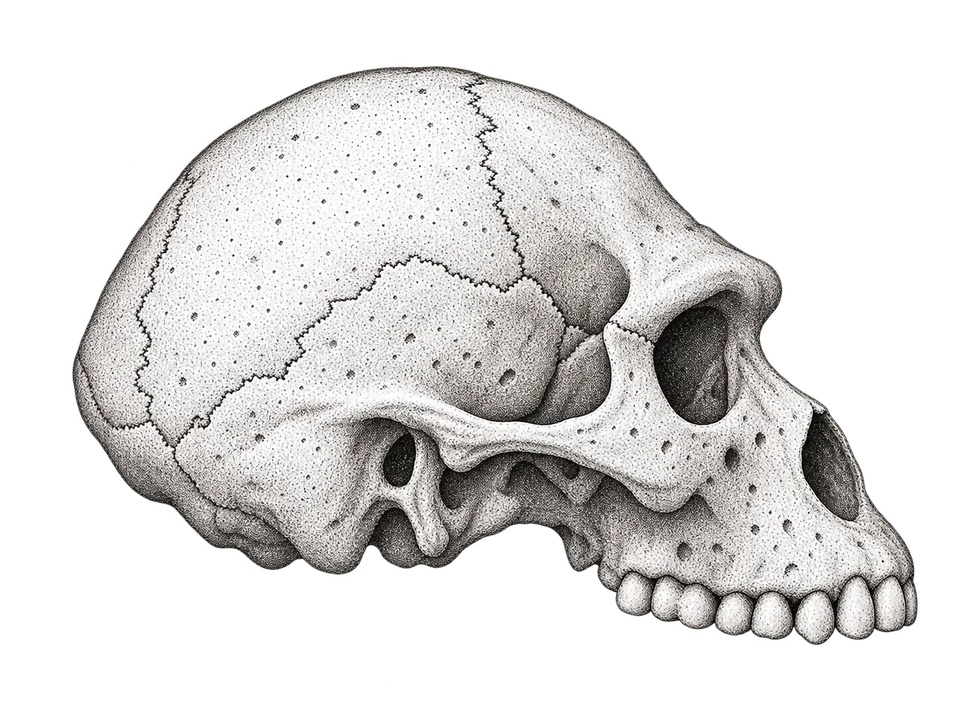
Ardi brings these changes together within a small cranial volume. The reconstructed skull supports an endocranial capacity of 300–350 cubic centimetres. Locomotor reorganization is therefore a substantial part of this release without a corresponding jump to the large braincase associated with later members of the family. (Suwa et al. 2009)
Its broader contribution is a revision of the starting architecture. White and colleagues argue that the last common ancestor of humans and chimpanzees differed from living African apes, with subsequent lineages developing their own specializations. We organize the family accordingly: branching development, retained capabilities, and distinct anatomical solutions. Ardi makes that structure visible in the product line. (White et al. 2009)
Specification sources & notes
Ardi's release estimate is the published approximate age of the Aramis skeleton and its fossil-bearing sediments: 4.4 million years. It dates this checkpoint, rather than the origin of the whole architecture. (White et al. 2009; WoldeGabriel et al. 1994)
Checkpoint and body metadata follow White et al. (2009) and the Smithsonian catalogue (Smithsonian n.d.). Cranial reconstruction follows Suwa et al. (2009); site dating follows WoldeGabriel et al. (1994).
Parameter estimate & method
22.3–25.7 billion neurons, calculated from the published 300–350 cm³ cranial-capacity interval (Suwa et al. 2009; Herculano-Houzel & Kaas 2011)
Hominid calculation: N = 109,239,790.169 × M^0.923, with M = cranial capacity × 1.06 g/cm³. The displayed range propagates the 300–350 cm³ input interval; it is not a confidence interval. (Suwa et al. 2009; Herculano-Houzel & Kaas 2011)
Timeline source & method
Architecture at scale
Inside the neural budget
Whole-brain neurons, billions
Solid bars show scaling estimates. Flores and Denisov extrapolate from individual reference skulls. Ardi’s hatched extension spans the published cranial-capacity interval; it is not a confidence interval. The outlined Sapiens-1 bar shows the adult human cell-count mean. Neural parameters here count neurons, not synapses or learned weights. Capacity alone does not measure intelligence.
Evidence & limitations
Place in the family tree
Sarmiento argues that the shared-derived characters give insufficient evidence that Ar. ramidus belongs exclusively to the human lineage, and that molecular and anatomical studies suggest it predates the human/African ape divergence (Sarmiento 2010); the research team replied (White et al. 2010b). Wood and Harrison caution, more generally, that shared skeletal morphology does not always mean shared recent evolutionary history (Wood & Harrison 2011).
Habitat
The research team describes a habitat that was largely woodland-focused (White et al. 2009). Cerling and colleagues read the same site as tree- or bush-savanna with 25 per cent or less woody canopy cover (Cerling et al. 2010); the team replied (White et al. 2010a).
The foot
A comparison across a large sample of anthropoid primates finds Ardi’s foot most similar to those of living chimpanzees and gorillas, which would make African ape-like terrestrial quadrupedalism and climbing the precursor of bipedalism (Prang 2019). The original description emphasized primitive characters that kept the foot rigid, reminiscent of some Miocene apes and Old World monkeys (Lovejoy et al. 2009a).
From the research program
Learning that compounds across models↗References
- Cerling, T. E. et al. Comment on the paleoenvironment of Ardipithecus ramidus. Science 328, 1105 (2010). doi:10.1126/science.1185274
- Herculano-Houzel, S. & Kaas, J. H. Gorilla and Orangutan Brains Conform to the Primate Cellular Scaling Rules: Implications for Human Evolution. Brain, Behavior and Evolution 77, 33–44 (2011). doi:10.1159/000322729
- Lovejoy, C. O., Latimer, B., Suwa, G., Asfaw, B. & White, T. D. Combining prehension and propulsion: The foot of Ardipithecus ramidus. Science 326, 72e1–72e8 (2009a). doi:10.1126/science.1175832
- Lovejoy, C. O., Suwa, G., Spurlock, L., Asfaw, B. & White, T. D. The pelvis and femur of Ardipithecus ramidus: The emergence of upright walking. Science 326, 71e1–71e6 (2009b). doi:10.1126/science.1175831
- Prang, T. C. The African ape-like foot of Ardipithecus ramidus and its implications for the origin of bipedalism. eLife 8, e44433 (2019). doi:10.7554/eLife.44433
- Sarmiento, E. E. Comment on the paleobiology and classification of Ardipithecus ramidus. Science 328, 1105 (2010). doi:10.1126/science.1184148
- Smithsonian National Museum of Natural History. Ardipithecus ramidus. What Does It Mean to Be Human? Human Origins Program (n.d.). humanorigins.si.edu/evidence/human-fossils/species/ardipithecus-ramidus
- Suwa, G. et al. The Ardipithecus ramidus skull and its implications for hominid origins. Science 326, 68e1–68e7 (2009). doi:10.1126/science.1175825
- White, T. D. et al. Ardipithecus ramidus and the paleobiology of early hominids. Science 326, 64, 75–86 (2009). doi:10.1126/science.1175802
- White, T. D., Ambrose, S. H., Suwa, G. & WoldeGabriel, G. Response to comment on the paleoenvironment of Ardipithecus ramidus. Science 328, 1105 (2010a). doi:10.1126/science.1185466
- White, T. D., Suwa, G. & Lovejoy, C. O. Response to comment on the paleobiology and classification of Ardipithecus ramidus. Science 328, 1105 (2010b). doi:10.1126/science.1185462
- WoldeGabriel, G. et al. Ecological and temporal placement of early Pliocene hominids at Aramis, Ethiopia. Nature 371, 330–333 (1994). doi:10.1038/371330a0
- Wood, B. & Harrison, T. The evolutionary context of the first hominins. Nature 470, 347–352 (2011). doi:10.1038/nature09709