Released ~200,000 years ago
Denisov
A wider operating range.
An adaptable architecture with a broad deployment map and a lasting contribution to the model family. Environmental range. Architecture exchange. Deep continuity.
- Neural capacity
- 93.6BNeurons · estimated
- Peak deployment
- 500KDevices · Illustrative scenario
A wider deployment map
Denisov extends the family across different operating environments. Its architecture record connects northern Asia, the Tibetan Plateau, and a broader network of inherited contributions.
Architecture exchange
Useful inherited features can move between model branches. Denisov makes that continuity part of the family’s development story, with contributions that remain in Sapiens-1 deployments.
Model card
- Release estimate
- ~200,000 years ago
- Checkpoint cranial capacity
- 1,420 cm³
- Architecture
- Denisovan lineage
- Genome checkpoint
- Denisova 3; approximately 30× coverage
- Cranial checkpoint
- Harbin, northeastern China
- Regional checkpoint
- Xiahe, Tibetan Plateau
- Dated deployment record
- Approximately 200,000–32,000 years ago
- Architecture exchange
- Denisovan-like EPAS1 ancestry in Tibetans
Research notes
Architecture & deployment
Deployment scale
Hominid peak-deployment scenario: 5,000,000 km² of occupied habitat at 0.1 devices per km². Both inputs are assumptions; the resulting 500,000 devices are an illustrative census estimate.
Open the architecture at sequence level
Denisov expands our model family with a lineage identified through molecular evidence. The Denisova 3 finger-bone specimen supplied a genome sequenced to approximately 30-fold coverage. It gives the release an inherited reference that can be compared with Neanderthal and Sapiens-1. (Meyer et al. 2012)
We use that reference to organize the architecture around relationships between populations. Denisov is a distinct branch with contributions that continue in living populations. A reference genome makes those relationships measurable while the physical and behavioral record develops through separately identified checkpoints.
Extend the operating range
The deployment record connects Siberia with the Tibetan Plateau. Ancient proteins identify the Xiahe mandible, dated to at least 160,000 years ago, as Denisovan. At Baishiya Karst Cave, a rib from a layer dated to approximately 48,000–32,000 years ago extends the record, alongside evidence of animal processing and bone-tool production. (Douka et al. 2019; Chen et al. 2019; Xia et al. 2024)
The map continues to expand. Protein analysis published in 2026 identified Denisovan remains at Bianfu Cave in southwestern China. We carry these geographically distinct checkpoints within the same molecularly defined lineage. Their environments and dates remain attached to the individual records. (Rao et al. 2026)
Connect a physical checkpoint to the lineage
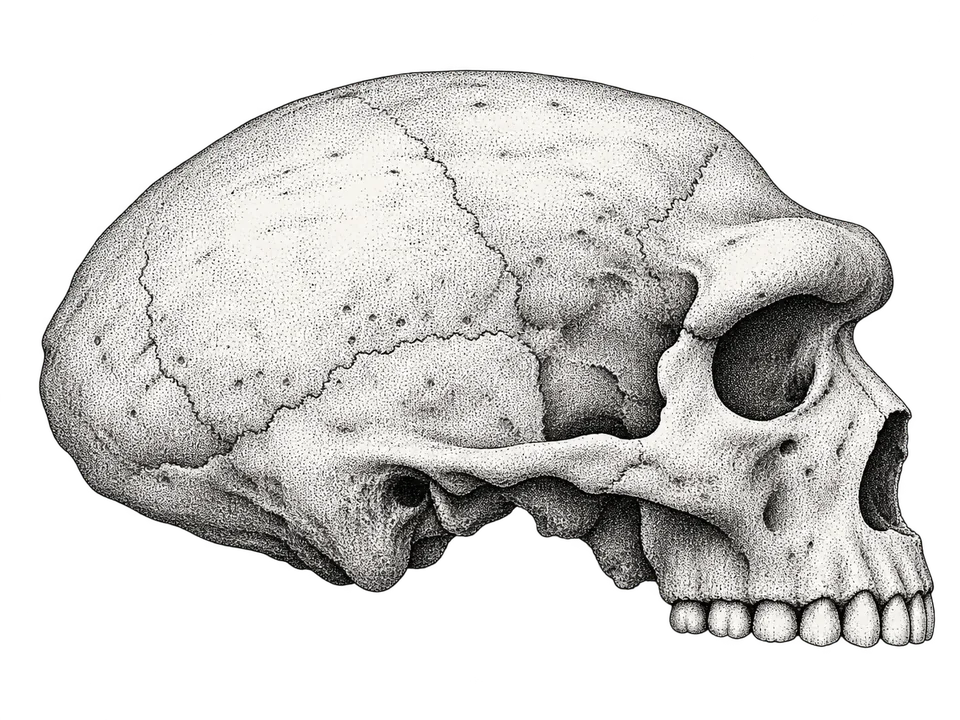
Harbin supplies a more complete cranial reference. Its published capacity is approximately 1,420 cubic centimetres. In 2025, separate studies of ancient proteins and mitochondrial DNA linked the individual to Denisovans. The cranial input used in our parameter calculation therefore belongs to an identified checkpoint. (Ni et al. 2021; Fu et al. 2025a, 2025b)
Architecture exchange is part of the release's lasting contribution. Denisovan-like inherited sequence at EPAS1 is associated with high-altitude adaptation in Tibetans. This is evidence of a contribution carried into Sapiens-1 populations; it does not establish a uniform altitude capability for every Denisov deployment. (Huerta-Sánchez et al. 2014)
Specification sources & notes
Denisov uses the approximately 200,000-year early fossil evidence from Denisova Cave reported by Brown and colleagues. The modelled age interval is 205–192 thousand years at 68.2% probability, or 217–187 thousand years at 95% probability. These fossils are separate from the Denisova 3 genome and Harbin cranial checkpoints; sediment DNA also records earlier presence within a broader 250–170-thousand-year interval. (Brown et al. 2021; Zavala et al. 2021)
Genome provenance follows Meyer et al. (2012). Cranial and regional checkpoint attribution follows Fu et al. (2025b) and Chen et al. (2019); chronology follows Douka et al. (2019) and Xia et al. (2024). Architecture exchange follows Huerta-Sánchez et al. (2014); the cranial measurement used for scaling follows Ni et al. (2021).
Parameter estimate & method
93.6 billion neurons, Hominid scaling extrapolation from the Harbin cranium; not a cell count or species mean (Ni et al. 2021; Fu et al. 2025b; Herculano-Houzel & Kaas 2011)
Hominid calculation: N = 109,239,790.169 × M^0.923, with M = 1,420 cm³ × 1.06 g/cm³. The input is the published cranial capacity of the Harbin cranium. Applying the primate scaling equation to this individual is an extrapolation; the fossil contains no measured neuron count. (Ni et al. 2021; Fu et al. 2025b; Herculano-Houzel & Kaas 2011)
Timeline source & method
Architecture at scale
Inside the neural budget
Whole-brain neurons, billions
Solid bars show scaling estimates. Flores and Denisov extrapolate from individual reference skulls. Ardi’s hatched extension spans the published cranial-capacity interval; it is not a confidence interval. The outlined Sapiens-1 bar shows the adult human cell-count mean. Neural parameters here count neurons, not synapses or learned weights. Capacity alone does not measure intelligence.
Evidence & limitations
A molecular lineage with multiple checkpoints
Denisovan is a lineage designation established through molecular comparisons. We do not assign every checkpoint to a universally settled Latin species name. Harbin's molecular identification does not make its anatomy a mean for all Denisovans. (Meyer et al. 2012; Fu et al. 2025a, 2025b)
Capacity comes from one cranium
The neural-capacity figure is Hominid's extrapolation from Harbin's cranial volume. It is not a fossil cell count, a measured intelligence score, or a lineage-wide average. (Ni et al. 2021; Herculano-Houzel & Kaas 2011)
Dated records are deployment boundaries
The timeline uses the approximately 200,000-year early Denisova fossil evidence and the youngest end of the Baishiya rib's dated layer. Sediment DNA also documents earlier presence within a broader 250,000–170,000-year interval. These are display boundaries for selected fossil records, not exact origin or extinction dates. Peak devices use the scenario documented in the architecture research notes. (Brown et al. 2021; Zavala et al. 2021; Xia et al. 2024)
From the research program
Architecture exchange across branches↗Compact architecture, real-world tools↗References
- Brown, S. et al. The earliest Denisovans and their cultural adaptation. Nature Ecology & Evolution 6, 28–35 (2021). doi:10.1038/s41559-021-01581-2
- Chen, F. et al. A late Middle Pleistocene Denisovan mandible from the Tibetan Plateau. Nature 569, 409–412 (2019). doi:10.1038/s41586-019-1139-x
- Douka, K. et al. Age estimates for hominin fossils and the onset of the Upper Palaeolithic at Denisova Cave. Nature 565, 640–644 (2019). doi:10.1038/s41586-018-0870-z
- Fu, Q. et al. Denisovan mitochondrial DNA from dental calculus of the >146,000-year-old Harbin cranium. Cell 188, 3919–3926.e9 (2025a). doi:10.1016/j.cell.2025.05.040
- Fu, Q. et al. The proteome of the late Middle Pleistocene Harbin individual. Science 389, 704–707 (2025b). doi:10.1126/science.adu9677
- Herculano-Houzel, S. & Kaas, J. H. Gorilla and Orangutan Brains Conform to the Primate Cellular Scaling Rules: Implications for Human Evolution. Brain, Behavior and Evolution 77, 33–44 (2011). doi:10.1159/000322729
- Huerta-Sánchez, E. et al. Altitude adaptation in Tibetans caused by introgression of Denisovan-like DNA. Nature 512, 194–197 (2014). doi:10.1038/nature13408
- Meyer, M. et al. A High-Coverage Genome Sequence from an Archaic Denisovan Individual. Science 338, 222–226 (2012). doi:10.1126/science.1224344
- Ni, X. et al. Massive cranium from Harbin in northeastern China establishes a new Middle Pleistocene human lineage. The Innovation 2, 100130 (2021). doi:10.1016/j.xinn.2021.100130
- Rao, H. et al. Ancient proteins identify various Denisovan remains from Southwest China. Nature, Published online 9 September 2026. doi:10.1038/s41586-026-10976-9
- Xia, H. et al. Middle and Late Pleistocene Denisovan subsistence at Baishiya Karst Cave. Nature 632, 108–113 (2024). doi:10.1038/s41586-024-07612-9
- Zavala, E. I. et al. Pleistocene sediment DNA reveals hominin and faunal turnovers at Denisova Cave. Nature 595, 399–403 (2021). doi:10.1038/s41586-021-03675-0