Released ~430,000 years ago
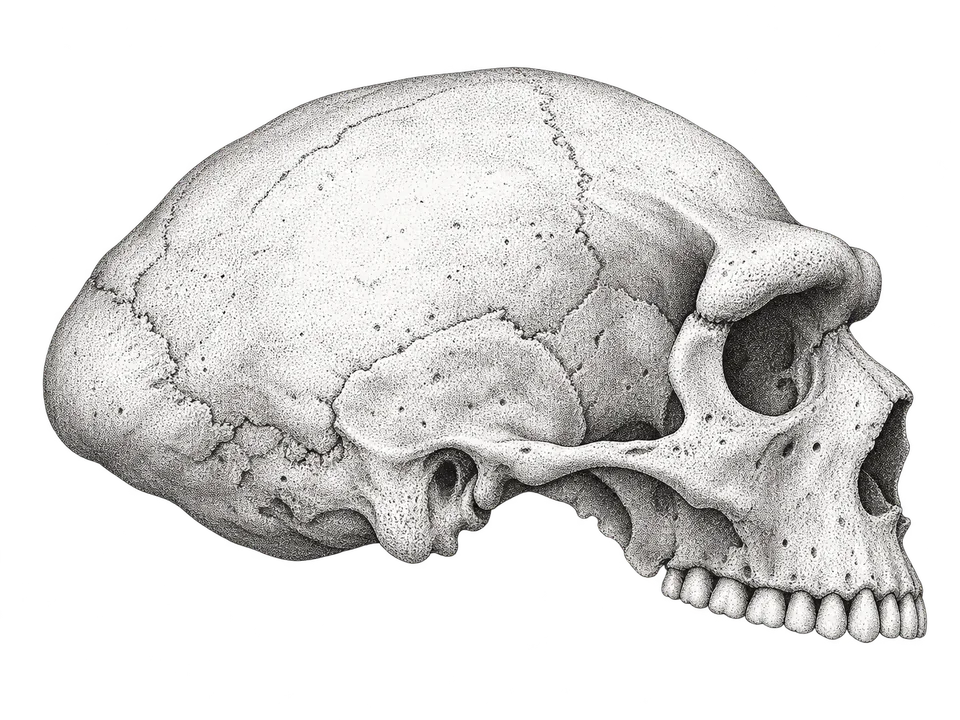
Neanderthal
High performance. Harsh conditions.
A high-capacity architecture for demanding environments. Robust execution, material engineering, and a substantial neural budget.
- Neural capacity
- 84.8BNeurons · estimated
- Peak deployment
- 70KDevices · Census estimate
Capacity under demanding conditions
Neanderthal combines a substantial neural budget with a robust embodied configuration. The release is built around operating in demanding environments.
Material engineering
The tool interface expands into a coordinated process of materials, preparation, and execution. Neanderthal develops this capability through an integrated embodied stack.
Model card
- Release estimate
- ~430,000 years ago
- Estimated brain mass
- 1,353 g
- Architecture
- Homo neanderthalensis
- Deployment
- Europe and southwestern to central Asia
- Reference genomes
- Altai and Vindija
- Shared ancestry
- 1.8–2.6% in present-day non-African populations
Research notes
Architecture & deployment
Deployment scale
The displayed peak estimate selects 70,000 devices, the upper end of the census range discussed in Bocquet-Appel & Degioanni (2013). A device is one living individual; this is a census estimate rather than a genetic effective population size.
Develop a regional specialist
We developed Neanderthal as a distinctive branch of the Hominid family. Its robust body and relatively short limb proportions suit a development history that includes cold environments across Europe and Asia. The release combines that physical specialization with a varied repertoire of material and social behavior. (Smithsonian n.d.)
Tools, hunting, fire, and evidence of care for others belong within the same operating picture. They connect the body's physical demands to ways of obtaining resources and sustaining individuals. Neanderthal's product identity comes from this combination: a recognizable anatomical configuration deployed through a substantial technical repertoire. (Smithsonian n.d.)
Open the inherited architecture
Neanderthal also changes the resolution at which we can examine a release. Green and colleagues' draft genome exposed inherited sequence for comparison with present-day humans. The greater similarity to populations outside Africa supplied evidence of gene flow, making exchange a measurable part of the development history. (Green et al. 2010)
We use these sequence references to examine relationships within the family. The high-coverage Altai genome adds a detailed comparison point, with its own population history. A genome gives access to inherited biological material; the behavioral evidence remains attached to the tools, sites, and bodies that preserve it. (Prüfer et al. 2014)
Carry contributions across branches
The Vindija genome refined estimates of Neanderthal ancestry in present-day non-African populations to 1.8–2.6 percent. A contribution from this branch remains within living members of the family. The result gives our release history a concrete form of continuity across populations that developed along different paths. (Prüfer et al. 2017)
We organize Neanderthal around that combination of specialization and exchange. Its distinct anatomy deserves a complete release narrative, while the genomic record connects it to later populations. Development in this family includes branching, coexistence, and inherited contributions; release order alone cannot describe how the architectures relate to one another.
Specification sources & notes
Neanderthal uses the approximately 430,000-year Sima de los Huesos population as an early lineage checkpoint. Cranial traits and nuclear DNA connect these hominins to the Neanderthal lineage. The estimate does not imply that all later Neanderthal features appeared at this date. (Arsuaga et al. 2014; Meyer et al. 2016)
Architecture and regional metadata follow the Smithsonian catalogue (Smithsonian n.d.). Genome checkpoints and ancestry estimates follow Prüfer et al. (2014) and Prüfer et al. (2017); the brain-mass input comes from Herculano-Houzel & Kaas (2011).
Parameter estimate & method
84.8 billion neurons, species-level scaling estimate (Herculano-Houzel & Kaas 2011)
Published whole-brain estimate from Table 4, using primate cellular scaling and reconstructed brain mass. (Herculano-Houzel & Kaas 2011)
Timeline source & method
Architecture at scale
Inside the neural budget
Whole-brain neurons, billions
Solid bars show scaling estimates. Flores and Denisov extrapolate from individual reference skulls. Ardi’s hatched extension spans the published cranial-capacity interval; it is not a confidence interval. The outlined Sapiens-1 bar shows the adult human cell-count mean. Neural parameters here count neurons, not synapses or learned weights. Capacity alone does not measure intelligence.
Evidence & limitations
Read capability in context
Fossils, artifacts, and genomes answer different questions. Genomic relatedness alone does not supply a numerical score for language, reasoning, or social intelligence.
From the research program
Benchmark drift in Sapiens-1↗References
- Arsuaga, J. L. et al. Neandertal roots: Cranial and chronological evidence from Sima de los Huesos. Science 344, 1358–1363 (2014). doi:10.1126/science.1253958
- Green, R. E. et al. A draft sequence of the Neandertal genome. Science 328, 710–722 (2010). doi:10.1126/science.1188021
- Herculano-Houzel, S. & Kaas, J. H. Gorilla and Orangutan Brains Conform to the Primate Cellular Scaling Rules: Implications for Human Evolution. Brain, Behavior and Evolution 77, 33–44 (2011). doi:10.1159/000322729
- Meyer, M. et al. Nuclear DNA sequences from the Middle Pleistocene Sima de los Huesos hominins. Nature 531, 504–507 (2016). doi:10.1038/nature17405
- Prüfer, K. et al. The complete genome sequence of a Neanderthal from the Altai Mountains. Nature 505, 43–49 (2014). doi:10.1038/nature12886
- Prüfer, K. et al. A high-coverage Neandertal genome from Vindija Cave in Croatia. Science 358, 655–658 (2017). doi:10.1126/science.aao1887
- Smithsonian National Museum of Natural History. Homo neanderthalensis. What Does It Mean to Be Human? Human Origins Program (n.d.). humanorigins.si.edu/evidence/human-fossils/species/homo-neanderthalensis