Released ~2.4 million years ago
Habilis
The world is now an interface.
A tool-oriented architecture that extends its capabilities through materials. Native tool use, real-world feedback, and an external execution loop.
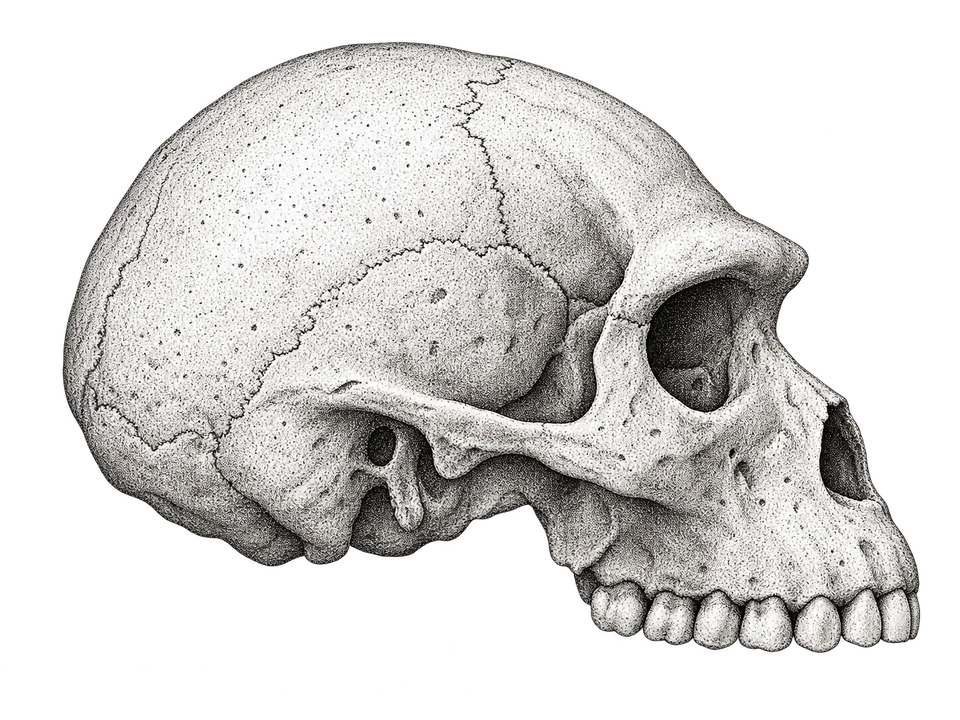
- Neural capacity
- 40.0BNeurons · estimated
- Peak deployment
- 500KDevices · Illustrative scenario
Native tool use
Habilis puts material operations at the center of the interface. A tool extends what the embodied system can execute, making the environment part of the working stack.
Incremental architecture upgrades
The release combines a larger neural budget with changes to the physical interface. Movement and material operations develop together across the model configuration.
Model card
- Release estimate
- ~2.4 million years ago
- Estimated brain mass
- 599 g
- Architecture
- Homo habilis
- Reference checkpoint
- OH 7, Olduvai Gorge
- Deployment range
- Eastern and southern Africa
- Body size
- 100–135 cm; about 32 kg
Research notes
Architecture & deployment
Deployment scale
Hominid peak-deployment scenario: 5,000,000 km² of occupied habitat at 0.1 devices per km². Both inputs are assumptions; the resulting 500,000 devices are an illustrative census estimate.
Extend the model through materials
Habilis brings material operations to the center of our development program. We present the release around an external tool interface: a body acting through an object whose useful properties can be changed. The original description of Homo habilis connected the species with the early toolmaking context at Olduvai Gorge. (Leakey et al. 1964)
A cutting edge changes what the system can accomplish without becoming part of its anatomy. This is the architectural shift Habilis foregrounds. The working system now includes the hand, the material being handled, and the effect produced by their interaction. A useful operation can reside partly outside the body that performs it.
Upgrade components at different rates
We developed the Habilis release as a coordinated set of changes with substantial inherited structure. Its anatomy combines an expanded braincase and smaller face and teeth relative to earlier australopiths with long arms and other retained features. The package establishes an early Homo configuration through changes that proceed at different rates. (Smithsonian n.d.)
That matters for the way the release is understood. Braincase, face, limbs, and material behavior are separate parts of the development story. A change in one does not supply a measurement of all the others. Habilis makes incremental architectural change visible: the new configuration remains connected to an existing body plan.
Support an interface with a longer history
The tool interface is shared development territory. The Lomekwi 3 assemblage described by Harmand and colleagues predates the Homo fossils discussed in that study. Material transformation was already present before Habilis, giving this release a technical inheritance rather than a claim to have invented all stone technology. (Harmand et al. 2015)
We therefore distinguish the operation from the architecture using it. Habilis belongs within a longer history of bodies extending their capabilities through materials. The release concentrates that theme in our family: change the object, expose a new affordance, and bring the resulting operation back into the body's repertoire.
Specification sources & notes
Habilis uses the rounded older boundary of the Smithsonian's approximately 2.4–1.4-million-year fossil range. The catalogue does not supply a single statistical median for the architecture's emergence; we retain its reported precision. (Smithsonian n.d.)
Architecture and checkpoint attribution follow Leakey et al. (1964); regional and body metadata follow the Smithsonian catalogue (Smithsonian n.d.). The brain-mass input comes from Herculano-Houzel & Kaas (2011).
Parameter estimate & method
40.0 billion neurons, species-level scaling estimate (Herculano-Houzel & Kaas 2011)
Published whole-brain estimate from Table 4, using primate cellular scaling and reconstructed brain mass. (Herculano-Houzel & Kaas 2011)
Timeline source & method
Architecture at scale
Inside the neural budget
Whole-brain neurons, billions
Solid bars show scaling estimates. Flores and Denisov extrapolate from individual reference skulls. Ardi’s hatched extension spans the published cranial-capacity interval; it is not a confidence interval. The outlined Sapiens-1 bar shows the adult human cell-count mean. Neural parameters here count neurons, not synapses or learned weights. Capacity alone does not measure intelligence.
Evidence & limitations
Attribution is not ownership
Multiple hominin species coexisted near early tool assemblages. A tool found near a fossil does not uniquely identify its maker. (Smithsonian n.d.; Harmand et al. 2015)
From the research program
A world model that moves with you↗References
- Harmand, S. et al. 3.3-million-year-old stone tools from Lomekwi 3, West Turkana, Kenya. Nature 521, 310–315 (2015). doi:10.1038/nature14464
- Herculano-Houzel, S. & Kaas, J. H. Gorilla and Orangutan Brains Conform to the Primate Cellular Scaling Rules: Implications for Human Evolution. Brain, Behavior and Evolution 77, 33–44 (2011). doi:10.1159/000322729
- Leakey, L. S. B., Tobias, P. V. & Napier, J. R. A new species of the genus Homo from Olduvai Gorge. Nature 202, 7–9 (1964). doi:10.1038/202007a0
- Smithsonian National Museum of Natural History. Homo habilis. What Does It Mean to Be Human? Human Origins Program (n.d.). humanorigins.si.edu/evidence/human-fossils/species/homo-habilis