Released ~315,000 years ago
Sapiens-1
The original general intelligence.
Our open-source flagship model for reasoning, creating, and figuring it out together. Native multimodality. Lifelong learning. Runs on lunch.
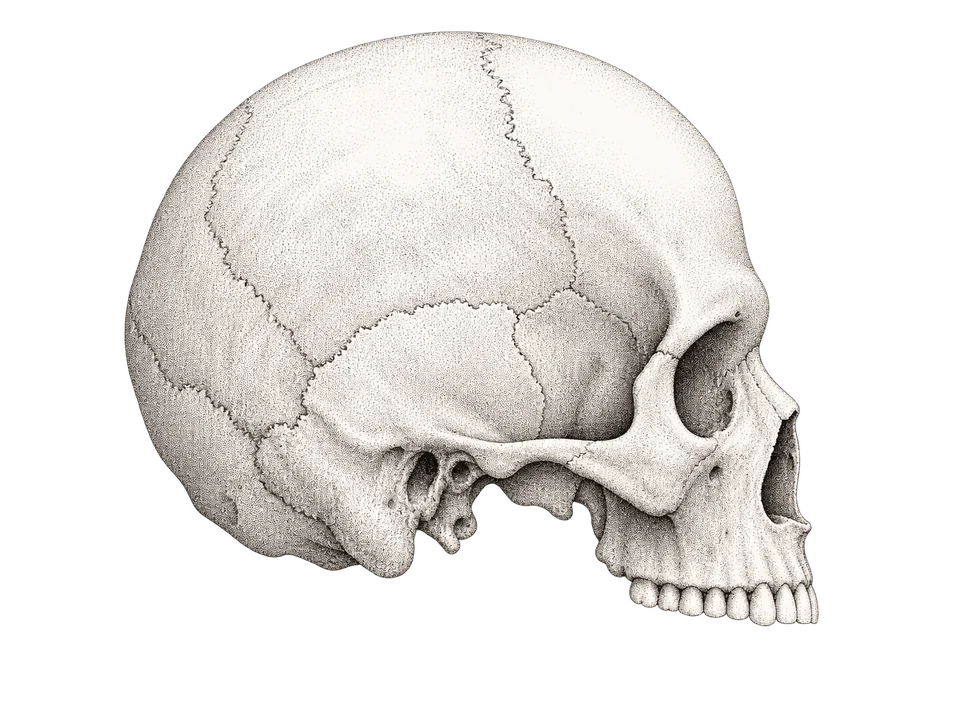
- Neural capacity
- 86BNeurons · measured mean
- Peak deployment
- 8.3BDevices · 2026 projection
General intelligence
Sapiens-1 brings reasoning, language, and creation into our flagship architecture. Perception and action share the context in which the model learns and works.
Learning across models
Teaching, shared procedures, and language let useful knowledge travel between deployments. Sapiens-1 makes collective learning a core part of the capability stack.
Model card
- Release estimate
- ~315,000 years ago
- Architecture
- Homo sapiens
- Power
- About 20 W
- Working memory
- ≈4 chunks · constrained tasks
- Genome reference
- T2T-CHM13 · 3.055B base pairs
- Offline mode
- Sleep-dependent memory processing
Research notes
Architecture & deployment
Deployment scale
Peak deployment through 2026 uses the rounded 2026 world population projection from UN World Population Prospects 2024. A device is one living individual.
Develop an extensible generalist
We developed Sapiens-1 as the generalist in our family: an architecture whose behavior continues to change through individual learning and shared knowledge. Its development brings several trajectories together. The Jebel Irhoud material combines a face and teeth aligned with modern humans with an elongated braincase, documenting a physical configuration that continued to change. (Hublin et al. 2017)
That combination gives the release its starting point. Different components reached their later forms at different times, within a broad African development history. We present Sapiens-1 as an evolving biological architecture with an open-ended behavioral repertoire, grounded in the separately documented histories of its anatomy, learning, and social transmission. (Hublin et al. 2017; Richter et al. 2017)
Keep learning after deployment
The release learns from brief encounters. Markson and Bloom demonstrated retention of newly introduced names and facts, while Horst and Samuelson distinguished successful referent selection from later recall in younger children. These results identify different parts of the learning system: extracting an association, retaining it, and making it available again. (Markson & Bloom 1997; Horst & Samuelson 2008)
We built our account of the runtime around those separate functions. Sapiens-1 can respond immediately using context, then continue developing what it knows through later experience. The few-shot learning report examines that transition in detail. The product capability is ongoing adaptation, with durable retrieval treated as its own requirement.
Give learning more than one timescale
Sapiens-1's memory system also processes experience between encounters. Rasch and Born's review describes sleep-related consolidation and reorganization; the effect depends on what was learned and how it is tested. The offline-learning report follows the mechanisms and experimental conditions behind that part of the architecture. (Rasch & Born 2013; Cordi & Rasch 2021)
Shared knowledge extends development across individuals. Experiments on cultural transmission show how information changes as one learner's output becomes another's input. We therefore describe Sapiens-1 at three connected timescales: the encounter, the interval that follows it, and the knowledge passed between learners. Each contributes a different form of continuity to the release. (Kirby et al. 2008)
Specification sources & notes
Sapiens-1 uses the published thermoluminescence weighted mean of 315 ± 34 thousand years for heated flints associated with the Jebel Irhoud fossils. This is a weighted mean, not a median or an exact origin date for Homo sapiens; the fossils preserve an early combination of sapiens features. (Richter et al. 2017; Hublin et al. 2017)
Neural capacity draws on Azevedo et al. (2009). Power, working-memory, and genome-reference specifications follow Balasubramanian (2021), Cowan (2001), and Nurk et al. (2022), respectively. Offline-mode notes follow the review by Rasch & Born (2013).
Parameter estimate & method
About 86 billion neurons, estimated by cell counting in adult male brains (Azevedo et al. 2009)
Whole-brain cell counts obtained with the isotropic fractionator. The reported mean describes the adult sample. (Azevedo et al. 2009)
Timeline source & method
Architecture at scale
Inside the neural budget
Whole-brain neurons, billions
Solid bars show scaling estimates. Flores and Denisov extrapolate from individual reference skulls. Ardi’s hatched extension spans the published cranial-capacity interval; it is not a confidence interval. The outlined Sapiens-1 bar shows the adult human cell-count mean. Neural parameters here count neurons, not synapses or learned weights. Capacity alone does not measure intelligence.
Evidence & limitations
Memory can generate the wrong past
The model reconstructs experiences and can incorporate misleading information into later recall. (Loftus & Palmer 1974; Roediger & McDermott 1995) Read the memory report.
Explanation is not direct access
Verbal explanations can reflect an inference about a decision rather than its actual cause. (Nisbett & Wilson 1977; Johansson et al. 2005) Read the reasoning-trace report.
The group changes the answer
Social pressure can change responses even on a simple visual task. Accuracy incentives reduce, but do not remove, the effect in a recent replication. (Franzen & Mader 2023) Read the alignment report.
References
- Azevedo, F. A. C. et al. Equal numbers of neuronal and nonneuronal cells make the human brain an isometrically scaled-up primate brain. Journal of Comparative Neurology 513, 532–541 (2009). doi:10.1002/cne.21974
- Balasubramanian, V. Brain power. Proceedings of the National Academy of Sciences 118, e2107022118 (2021). doi:10.1073/pnas.2107022118
- Cordi, M. J. & Rasch, B. How robust are sleep-mediated memory benefits? Current Opinion in Neurobiology 67, 1–7 (2021). doi:10.1016/j.conb.2020.06.002
- Cowan, N. The magical number 4 in short-term memory: A reconsideration of mental storage capacity. Behavioral and Brain Sciences 24, 87–114 (2001). doi:10.1017/S0140525X01003922
- Franzen, A. & Mader, S. The power of social influence: A replication and extension of the Asch experiment. PLOS ONE 18, e0294325 (2023). doi:10.1371/journal.pone.0294325
- Horst, J. S. & Samuelson, L. K. Fast mapping but poor retention by 24-month-old infants. Infancy 13, 128–157 (2008). doi:10.1080/15250000701795598
- Hublin, J.-J. et al. New fossils from Jebel Irhoud, Morocco and the pan-African origin of Homo sapiens. Nature 546, 289–292 (2017). doi:10.1038/nature22336
- Johansson, P., Hall, L., Sikström, S. & Olsson, A. Failure to detect mismatches between intention and outcome in a simple decision task. Science 310, 116–119 (2005). doi:10.1126/science.1111709
- Loftus, E. F. & Palmer, J. C. Reconstruction of automobile destruction: An example of the interaction between language and memory. Journal of Verbal Learning and Verbal Behavior 13, 585–589 (1974). doi:10.1016/S0022-5371(74)80011-3
- Markson, L. & Bloom, P. Evidence against a dedicated system for word learning in children. Nature 385, 813–815 (1997). doi:10.1038/385813a0
- Nisbett, R. E. & Wilson, T. D. Telling more than we can know: Verbal reports on mental processes. Psychological Review 84, 231–259 (1977). doi:10.1037/0033-295X.84.3.231
- Nurk, S. et al. The complete sequence of a human genome. Science 376, 44–53 (2022). doi:10.1126/science.abj6987
- Rasch, B. & Born, J. About sleep’s role in memory. Physiological Reviews 93, 681–766 (2013). doi:10.1152/physrev.00032.2012
- Richter, D. et al. The age of the hominin fossils from Jebel Irhoud, Morocco, and the origins of the Middle Stone Age. Nature 546, 293–296 (2017). doi:10.1038/nature22335
- Roediger, H. L. & McDermott, K. B. Creating false memories: Remembering words not presented in lists. Journal of Experimental Psychology: Learning, Memory, and Cognition 21, 803–814 (1995). doi:10.1037/0278-7393.21.4.803
- Simon Kirby, Hannah Cornish, and Kenny Smith. Cumulative cultural evolution in the laboratory: An experimental approach to the origins of structure in human language. PNAS 105(31), 10681–10686 (2008). doi:10.1073/pnas.0707835105