Released ~3.18 million years ago
Lucy
Less overhead. More ground covered.
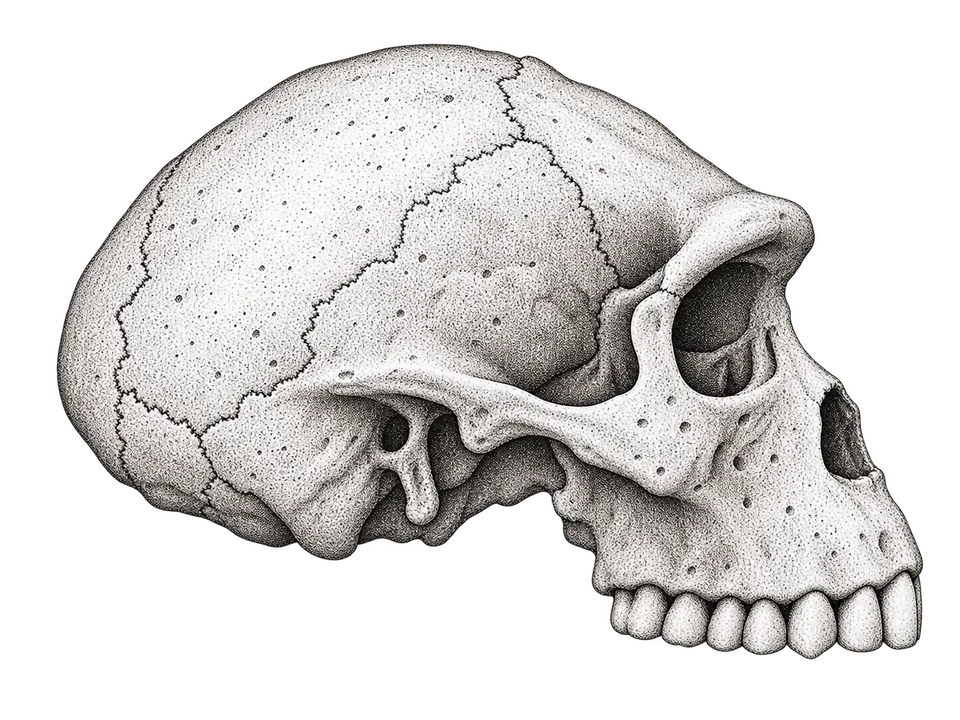
A compact embodied architecture with stable locomotion and an extended learning cycle.
- Neural capacity
- 34.7BNeurons · estimated
- Peak deployment
- 200KDevices · Illustrative scenario
Stable embodied operation
Lucy establishes sustained upright locomotion as a foundation for embodied operation. The release integrates support, balance, and movement in a compact architecture.
An extended development cycle
Developmental timing becomes part of the architecture. Lucy advances the model family with a longer growth schedule alongside its locomotion stack.
Model card
- Release estimate
- ~3.18 million years ago
- Estimated brain mass
- 514 g
- Checkpoint
- AL 288-1
- Training region
- Hadar, Afar region, Ethiopia
- Brain capacity
- Brain usually under 500 cm³
- Form factor
- Female average 105 cm, 29 kg
- Weights recovered
- ~40% of one skeleton
- Locomotion
- Bipedal; climbing disputed
- Deployment
- 3.85–2.95 million years ago
- Instances recovered
- More than 300 individuals
Research notes
Architecture & deployment
Deployment scale
Hominid peak-deployment scenario: 2,000,000 km² of occupied habitat at 0.1 devices per km². Both inputs are assumptions; the resulting 200,000 devices are an illustrative census estimate.
Make walking a stable foundation
Lucy advances our locomotion program with a body organized for upright walking. In Australopithecus afarensis, the arched foot provides structural support for terrestrial bipedality, while the Laetoli trails record actual movement across the ground. Anatomy and footprints give this release complementary evidence for its central operating mode. (Ward et al. 2011; Leakey & Hay 1979)
We developed Lucy around this dependable physical foundation: support the body, transfer weight, and continue moving on two feet. The distinctive release feature is the integration of those demands into the lower limb and foot. Walking becomes a sustained architectural commitment, available within a compact body rather than waiting for the proportions of later Homo.
Retain useful upper-body capability
The transition does not replace every component at once. Lucy's species retains long, strong arms and curved fingers alongside its walking anatomy. The upper body therefore remains an important part of the release, and its contribution to climbing is a separate question from the well-supported capacity to walk upright. (Smithsonian n.d.; Stern & Susman 1983)
We keep those functions visible instead of collapsing the architecture into one label. A foot adapted to ground support and an upper limb with arboreal characteristics describe different parts of the same system. Lucy's development shows how a stable new operating mode can arrive while other inherited capabilities remain in the body.
Change the development schedule
Lucy also changes how we think about scaling. Gunz and colleagues found ape-like brain organization in the species' endocasts, alongside evidence of prolonged brain growth from comparisons between infants and adults. The developmental schedule is changing before the appearance of a large, modern human brain. (Gunz et al. 2020)
We treat growth time as an architectural dimension alongside adult size. The finding supplies a developmental basis for studying an extended period of learning, without assigning Lucy a modern cognitive profile. With a species deployment spanning more than 900,000 years, this combination of walking anatomy and developmental timing forms a substantial, durable release in its own right. (Gunz et al. 2020; Smithsonian n.d.)
Specification sources & notes
Lucy's release estimate follows the approximately 3.18-million-year age of AL 288-1, constrained by dated volcanic horizons at Hadar. This checkpoint age differs from the longer deployment interval of Australopithecus afarensis. (Walter 1994; Russ 2024)
Checkpoint recovery and dating follow Russ (2024) and Walter (1994). Species metadata follows the Smithsonian catalogue (Smithsonian n.d.); locomotion notes follow Ward et al. (2011) and Stern & Susman (1983). The brain-mass input comes from Herculano-Houzel & Kaas (2011).
Parameter estimate & method
34.7 billion neurons, species-level scaling estimate (Herculano-Houzel & Kaas 2011)
Published whole-brain estimate from Table 4, using primate cellular scaling and reconstructed brain mass. (Herculano-Houzel & Kaas 2011)
Timeline source & method
Architecture at scale
Inside the neural budget
Whole-brain neurons, billions
Solid bars show scaling estimates. Flores and Denisov extrapolate from individual reference skulls. Ardi’s hatched extension spans the published cranial-capacity interval; it is not a confidence interval. The outlined Sapiens-1 bar shows the adult human cell-count mean. Neural parameters here count neurons, not synapses or learned weights. Capacity alone does not measure intelligence.
Evidence & limitations
Time in the trees
Stern and Susman found anatomy indicating a significant adaptation for movement in the trees, and suggested that larger, presumably male individuals were less arboreal (Stern & Susman 1983). Ward and colleagues read the arched foot as the mark of a committed terrestrial biped (Ward et al. 2011). The two views differ on how much climbing mattered, not on whether the species walked upright.
Cause of death
Kappelman and colleagues interpret compressive and hinge fractures in several bones as the result of a fall from considerable height, probably out of a tall tree (Kappelman et al. 2016). A forensic reanalysis argues that a vertical deceleration cannot be the only cause and proposes a mudslide and/or an animal attack (Charlier et al. 2018).
Tool use
Bones from Dikika, Ethiopia, older than 3.39 million years, carry marks reported as stone-tool cut marks and percussion marks. If so, tool-assisted meat-eating began about 800,000 years earlier than thought, and can be attributed to A. afarensis (McPherron et al. 2010). A taphonomic reanalysis attributes the marks on the two bones to trampling and keeps the earliest best evidence for butchery at 2.6 to 2.5 million years ago (Domínguez-Rodrigo et al. 2010).
From the research program
A world model that moves with you↗References
- Charlier, P. et al. Mudslide and/or animal attack are more plausible causes and circumstances of death for AL 288 (‘Lucy’): A forensic anthropology analysis. Medico-Legal Journal 86, 139–142 (2018). doi:10.1177/0025817217749504
- Domínguez-Rodrigo, M., Pickering, T. R. & Bunn, H. T. Configurational approach to identifying the earliest hominin butchers. Proceedings of the National Academy of Sciences 107, 20929–20934 (2010). doi:10.1073/pnas.1013711107
- Gunz, P. et al. Australopithecus afarensis endocasts suggest ape-like brain organization and prolonged brain growth. Science Advances 6, eaaz4729 (2020). doi:10.1126/sciadv.aaz4729
- Herculano-Houzel, S. & Kaas, J. H. Gorilla and Orangutan Brains Conform to the Primate Cellular Scaling Rules: Implications for Human Evolution. Brain, Behavior and Evolution 77, 33–44 (2011). doi:10.1159/000322729
- Kappelman, J. et al. Perimortem fractures in Lucy suggest mortality from fall out of tall tree. Nature 537, 503–507 (2016). doi:10.1038/nature19332
- Leakey, M. D. & Hay, R. L. Pliocene footprints in the Laetolil Beds at Laetoli, northern Tanzania. Nature 278, 317–323 (1979). doi:10.1038/278317a0
- McPherron, S. P. et al. Evidence for stone-tool-assisted consumption of animal tissues before 3.39 million years ago at Dikika, Ethiopia. Nature 466, 857–860 (2010). doi:10.1038/nature09248
- Russ, J. Lucy’s lasting legacy: Donald Johanson reflects on the discovery of a lifetime. ASU News, 21 November 2024. news.asu.edu/20241121-science-and-technology-lucys-lasting-legacy-donald-johanson-reflects-discovery-lifetime
- Smithsonian National Museum of Natural History. Australopithecus afarensis. What Does It Mean to Be Human? Human Origins Program (n.d.). humanorigins.si.edu/evidence/human-fossils/species/australopithecus-afarensis
- Stern, J. T., Jr. & Susman, R. L. The locomotor anatomy of Australopithecus afarensis. American Journal of Physical Anthropology 60, 279–317 (1983). doi:10.1002/ajpa.1330600302
- Walter, R. C. Age of Lucy and the First Family: Single-crystal 40Ar/39Ar dating of the Denen Dora and lower Kada Hadar members of the Hadar Formation, Ethiopia. Geology 22, 6–10 (1994). doi:10.1130/0091-7613(1994)022<0006:AOLATF>2.3.CO;2
- Ward, C. V., Kimbel, W. H. & Johanson, D. C. Complete fourth metatarsal and arches in the foot of Australopithecus afarensis. Science 331, 750–753 (2011). doi:10.1126/science.1201463