Released ~7 million years ago
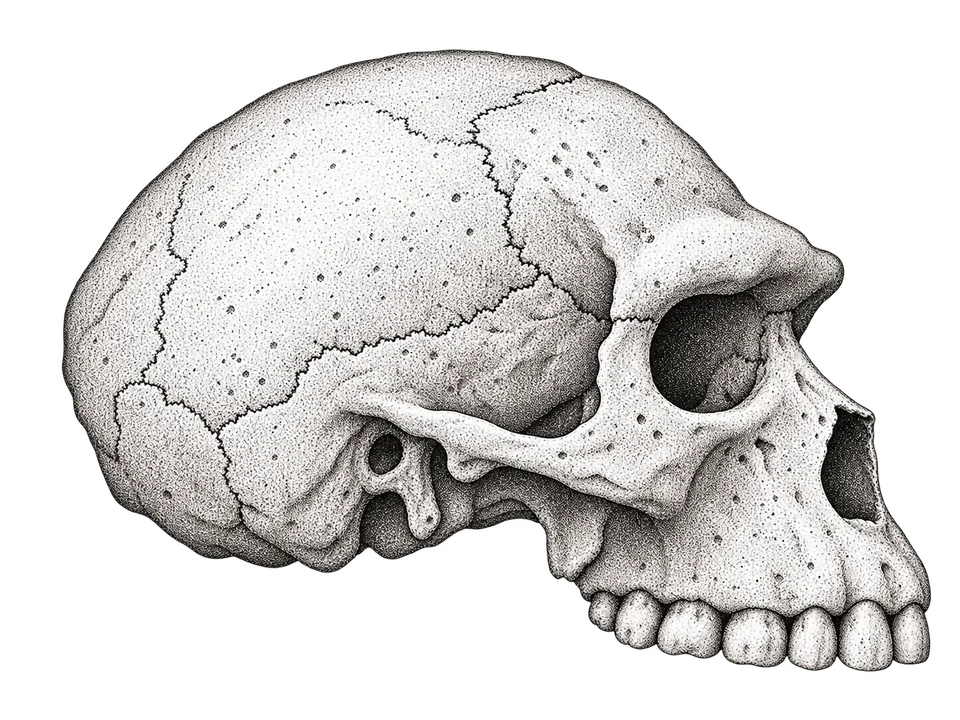
Toumaï
A new direction for intelligence.
Our earliest experiment in embodied reasoning. A lightweight foundation with a radically different point of view.
- Neural capacity
- 25.2BNeurons · estimated
- Peak deployment
- 50KDevices · Illustrative scenario
Embodied foundations
Toumaï starts the model family with a compact embodied architecture. Its development focus is the physical interface between the model and its environment.
Architecture before scale
A compact neural budget keeps the focus on physical configuration. Later releases expand the movement, reach, and control stack.
Model card
- Release estimate
- ~7 million years ago
- Estimated brain mass
- 363 g
- Checkpoint
- TM 266-01-060-1
- Training region
- Toros-Menalla, Djurab Desert, Chad
- Brain capacity
- Brain about 360 cm³
- Weights recovered
- Nearly complete cranium; fragmentary lower jaws
- Environment
- Near a lake, not far from a sandy desert
- Locomotion
- Disputed
Research notes
Architecture & deployment
Deployment scale
Hominid peak-deployment scenario: 500,000 km² of occupied habitat at 0.1 devices per km². Both inputs are assumptions; the resulting 50,000 devices are an illustrative census estimate.
Start with the body
With Toumaï, we began our development program at the physical interface: how a head, spine, and body fit together. The release combines a compact braincase with a distinctive arrangement of facial and cranial features. Its significance comes from the configuration of those parts, rather than a large increase in brain volume. (Brunet et al. 2002; Institute of Human Origins n.d.)
We made posture a core architectural concern. A model meets its environment through the body that carries it; changing that body's orientation changes the locomotor problem. Toumaï establishes this direction in our family, with the base of the reconstructed skull supplying evidence relevant to an upright stance. (Zollikofer et al. 2005)
Develop the locomotion system together
The development question spans the whole support system. Daver and colleagues' analysis of a femur and two forearm bones from Toros-Menalla supports habitual bipedality alongside substantial movement in trees. We carry both requirements into the release: terrestrial support and an upper body still involved in navigating branches. (Daver et al. 2022)
This gives Toumaï a different technical story from a modern walking specialist. The anatomy supports an early combination of locomotor functions. The detailed interpretations of the limb material remain documented below, so the release's physical configuration can be examined independently of any claim about its learning, reasoning, or social abilities.
Expand the deployment map
Toumaï also expands where our development history takes place. Toros-Menalla lies far west of the East African Rift, in a setting whose associated animals indicate proximity to water and a varied surrounding landscape. We treat that environmental context as part of the architecture's deployment record. (Brunet et al. 2002; Vignaud et al. 2002)
The result is a starting point that is geographically broad and physically specific. Development begins with a compact embodied system, a changing relationship to upright movement, and multiple demands on the same limbs. These are the foundations Toumaï contributes to the program; later releases develop their own combinations of support, reach, and movement.
Specification sources & notes
Toumaï's release estimate follows the 6.8–7.2-million-year interval for the fossil-bearing sediments at Toros-Menalla. Approximately 7 million years is a rounded representative age, not an exact calendar date or a measured posterior median. (Lebatard et al. 2008)
Checkpoint metadata follows Brunet et al. (2002) and the Institute of Human Origins catalogue (Institute of Human Origins n.d.). Dating follows Lebatard et al. (2008); site context follows Vignaud et al. (2002). The brain-mass input comes from Herculano-Houzel & Kaas (2011).
Parameter estimate & method
25.2 billion neurons, species-level scaling estimate (Herculano-Houzel & Kaas 2011)
Published whole-brain estimate from Table 4, using primate cellular scaling and reconstructed brain mass. (Herculano-Houzel & Kaas 2011)
Timeline source & method
Architecture at scale
Inside the neural budget
Whole-brain neurons, billions
Solid bars show scaling estimates. Flores and Denisov extrapolate from individual reference skulls. Ardi’s hatched extension spans the published cranial-capacity interval; it is not a confidence interval. The outlined Sapiens-1 bar shows the adult human cell-count mean. Neural parameters here count neurons, not synapses or learned weights. Capacity alone does not measure intelligence.
Evidence & limitations
Hominid or ape
Wolpoff and colleagues questioned whether the cranium belonged to a hominid at all, under the title ‘Sahelanthropus or “Sahelpithecus”?’ (Wolpoff et al. 2002); Brunet’s team replied (Brunet 2002). The virtual reconstruction supports a hominid (Zollikofer et al. 2005).
Upright or not
A partial femur recovered at the same site in July 2001, and recognized as a probable primate femur in 2004, was described in 2020 as belonging to an individual that was not habitually bipedal (Macchiarelli et al. 2020). A 2022 study of a femur and two ulnae from the site finds the femur most parsimonious with habitual bipedality and the ulnae evidence of substantial arboreal behaviour, so that arboreal clambering was probably a significant part of the repertoire (Daver et al. 2022). The 2020 authors also note that the femur could belong to a hominid otherwise unrepresented at the site, though S. tchadensis is the more parsimonious attribution (Macchiarelli et al. 2020).
From the research program
Benchmark drift in Sapiens-1↗References
- Brunet, M. Sahelanthropus or ‘Sahelpithecus’? (reply). Nature 419, 582 (2002). doi:10.1038/419582a
- Brunet, M. et al. A new hominid from the Upper Miocene of Chad, Central Africa. Nature 418, 145–151 (2002). doi:10.1038/nature00879
- Daver, G. et al. Postcranial evidence of late Miocene hominin bipedalism in Chad. Nature 609, 94–100 (2022). doi:10.1038/s41586-022-04901-z
- Herculano-Houzel, S. & Kaas, J. H. Gorilla and Orangutan Brains Conform to the Primate Cellular Scaling Rules: Implications for Human Evolution. Brain, Behavior and Evolution 77, 33–44 (2011). doi:10.1159/000322729
- Institute of Human Origins. Sahelanthropus tchadensis. Becoming Human, Arizona State University (n.d.). becominghuman.org/hominin-fossils/sahelanthropus-tchadensis/
- Lebatard, A.-E. et al. Cosmogenic nuclide dating of Sahelanthropus tchadensis and Australopithecus bahrelghazali: Mio-Pliocene hominids from Chad. Proceedings of the National Academy of Sciences 105, 3226–3231 (2008). doi:10.1073/pnas.0708015105
- Macchiarelli, R., Bergeret-Medina, A., Marchi, D. & Wood, B. Nature and relationships of Sahelanthropus tchadensis. Journal of Human Evolution 149, 102898 (2020). doi:10.1016/j.jhevol.2020.102898
- Vignaud, P. et al. Geology and palaeontology of the Upper Miocene Toros-Menalla hominid locality, Chad. Nature 418, 152–155 (2002). doi:10.1038/nature00880
- Wolpoff, M. H., Senut, B., Pickford, M. & Hawks, J. Sahelanthropus or ‘Sahelpithecus’? Nature 419, 581–582 (2002). doi:10.1038/419581a
- Zollikofer, C. P. E. et al. Virtual cranial reconstruction of Sahelanthropus tchadensis. Nature 434, 755–759 (2005). doi:10.1038/nature03397