Released ~80,000 years ago
Flores
Capability in a compact footprint.
A compact island architecture that brings embodied operation and material tools into a smaller physical footprint. A distinct branch of the model family, shaped by a bounded environment.
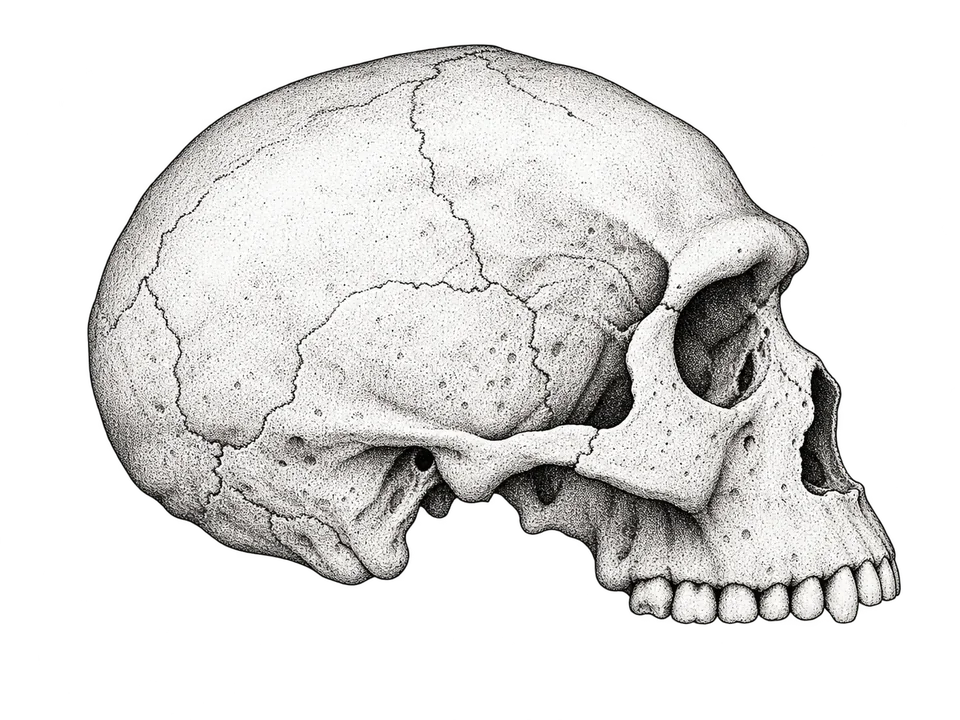
- Neural capacity
- 30.8BNeurons · estimated
- Peak deployment
- 1KDevices · Illustrative scenario
Compact embodied operation
Flores brings a distinct physical configuration to the family. A smaller body and neural budget make the architecture a useful reference for developing capability within a compact footprint.
Material tools within reach
The environment remains part of the execution stack. Flores connects a compact embodied system with material operations, extending its working interface beyond the body.
Model card
- Release estimate
- ~80,000 years ago
- Checkpoint cranial capacity
- 426 cm³
- Architecture
- Homo floresiensis
- Reference checkpoint
- LB1
- Deployment
- Liang Bua, Flores, Indonesia
- Dated skeletal record
- Approximately 100,000–60,000 years ago
- Associated tool record
- Approximately 190,000–50,000 years ago
Research notes
Architecture & deployment
Deployment scale
Hominid peak-deployment scenario: 10,000 km² of occupied habitat at 0.1 devices per km². Both inputs are assumptions; the resulting 1,000 devices are an illustrative census estimate.
Develop within a compact footprint
Flores brings a compact embodied architecture into the model family. The original description of Homo floresiensis established a small-bodied hominin at Liang Bua on the Indonesian island of Flores. LB1 is our reference checkpoint, connecting the release's physical scale to a named specimen. (Brown et al. 2004)
A later high-resolution reconstruction measured LB1's endocranial volume at 426 cubic centimetres. We use that published input for the parameter calculation. The compact footprint is part of the architecture's identity; volume alone does not quantify what the model could learn or accomplish. (Kubo et al. 2013)
Keep useful operations outside the body
The Liang Bua record includes stone artifacts attributed to Homo floresiensis. The revised chronology places those artifacts between about 190,000 and 50,000 years ago. We treat this material record as the basis for the release's tool interface. (Sutikna et al. 2016)
This architecture develops our family along a different dimension from a larger braincase. Useful action can depend on the body, an external cutting edge, and the material being worked. Flores makes that compact combination visible in the model catalog, with each capability grounded in the surviving physical record.
Keep the checkpoint and its date together
Renewed excavation revised the Liang Bua chronology. The skeletal remains are dated to approximately 100,000–60,000 years ago. Our timeline uses that interval for the architecture's displayed deployment, separately from the longer associated artifact record. (Sutikna et al. 2016)
Flores is a distinct model in the family, with its own body plan, reference checkpoint, and deployment context. We describe that combination directly. Questions about its deeper ancestry and the timing of its disappearance remain research questions rather than product version numbers.
Specification sources & notes
Flores uses the Smithsonian's approximate 80,000-year age for the LB1 reference skeleton. The revised Liang Bua skeletal interval is approximately 100,000–60,000 years. This checkpoint estimate is separate from both the older end of that interval and the longer associated stone-artifact record; it is not a directly measured posterior median. (Smithsonian 2016; Sutikna et al. 2016)
Architecture and checkpoint provenance follow Brown et al. (2004). Cranial measurement follows Kubo et al. (2013); the skeletal and associated-tool chronologies follow Sutikna et al. (2016).
Parameter estimate & method
30.8 billion neurons, Hominid scaling extrapolation from LB1; not a cell count or species mean (Kubo et al. 2013; Herculano-Houzel & Kaas 2011)
Hominid calculation: N = 109,239,790.169 × M^0.923, with M = 426 cm³ × 1.06 g/cm³. The input is the published cranial capacity of LB1. Applying the primate scaling equation to this individual is an extrapolation; the fossil contains no measured neuron count. (Kubo et al. 2013; Herculano-Houzel & Kaas 2011)
Timeline source & method
Architecture at scale
Inside the neural budget
Whole-brain neurons, billions
Solid bars show scaling estimates. Flores and Denisov extrapolate from individual reference skulls. Ardi’s hatched extension spans the published cranial-capacity interval; it is not a confidence interval. The outlined Sapiens-1 bar shows the adult human cell-count mean. Neural parameters here count neurons, not synapses or learned weights. Capacity alone does not measure intelligence.
Evidence & limitations
A checkpoint is not a species average
The 426 cm³ measurement describes LB1. The displayed neuron estimate applies a primate scaling equation to that volume; it is not a measured cell count or an IQ score. (Kubo et al. 2013; Herculano-Houzel & Kaas 2011)
Separate skeletons from tools
The skeletal and associated artifact intervals differ. Neither endpoint establishes the exact extinction date, and the revised chronology leaves overlap with arriving Sapiens populations unresolved. (Sutikna et al. 2016)
Keep deployment assumptions visible
Peak devices are a Hominid occupied-habitat scenario, documented in the architecture research notes. The fossil record supplies no direct population census or numerical benchmark for language and reasoning.
From the research program
Compact architecture, real-world tools↗A world model that moves with you↗References
- Brown, P. et al. A new small-bodied hominin from the Late Pleistocene of Flores, Indonesia. Nature 431, 1055–1061 (2004). doi:10.1038/nature02999
- Herculano-Houzel, S. & Kaas, J. H. Gorilla and Orangutan Brains Conform to the Primate Cellular Scaling Rules: Implications for Human Evolution. Brain, Behavior and Evolution 77, 33–44 (2011). doi:10.1159/000322729
- Kubo, D., Kono, R. T. & Kaifu, Y. Brain size of Homo floresiensis and its evolutionary implications. Proceedings of the Royal Society B 280, 20130338 (2013). doi:10.1098/rspb.2013.0338
- Smithsonian National Museum of Natural History. The extinct ‘hobbit’ of human evolution. Human Origins Program (2016). humanorigins.si.edu/research/whats-hot-human-origins/new-date-homo-floresiensis
- Sutikna, T. et al. Revised stratigraphy and chronology for Homo floresiensis at Liang Bua in Indonesia. Nature 532, 366–369 (2016). doi:10.1038/nature17179